
11th January 2025
When I woke there was a small coating of condensation on my blanket, another reminder of the jungles humidity. Today we would be ascending 1200 irregular, original stone steps to the Lost City. The walk started at dawn and involved first following the edge of the river on damp, grey sand followed by elevated wooden walkways hugging the rocky wall.
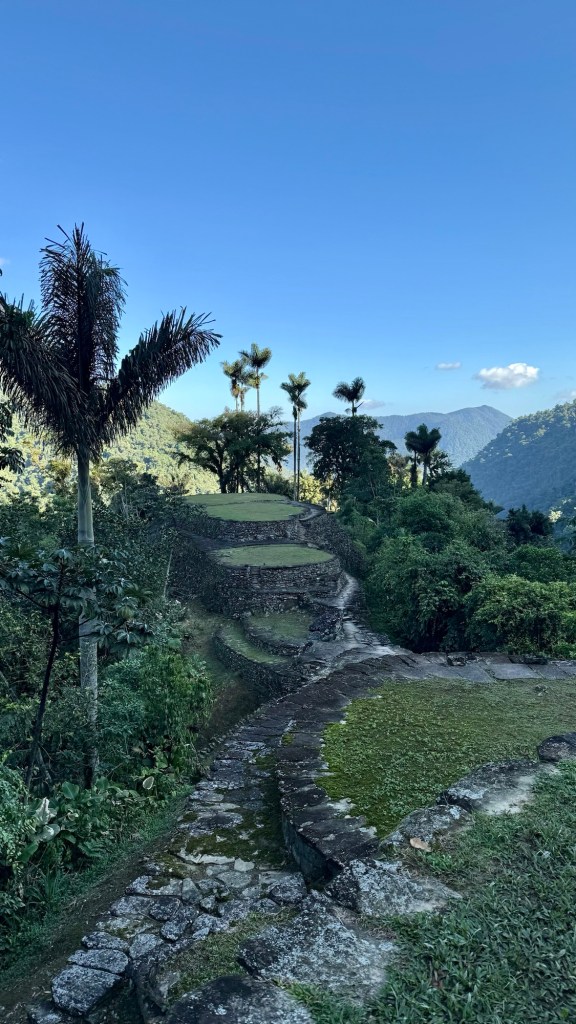
The steps ascended quickly away from the river and into the thick jungle. Before long we arrived at the the city, a vision of green with familiar stone tiered platforms under large palm trees, which you had to crane your neck to see the tops of. It was difficult not to compare the Lost City to Machu Picchu. Firstly, the architecture of both cities had been built to increase agricultural yields, and withstand earthquakes and mudslides. Therefore, both used stone terraces to achieve this and sloping the city downwards to avoid flooding. Secondly, the sun is a spiritual figure in both cultures with buildings designed in relation to the sun’s position in the sky. Finally, and perhaps the most obvious, was the location. Both were built high in the mountains in a hostile jungles close to naturally occurring water springs. I was surprised at how similar the cultures were despite being over 600 years and 4500km apart.
The tour of the city was split into four sectors. The first, was thought to be a market. The second sector was believed to be a forge where decorative gold and other metal objects were made. This may have been my favourite place, it was quiet and hosted a large tree with many vines descending down the staggered ruins built into the mountainside. Birdsong filled the area, each song unique and exotic.
The third sector involved climbing higher into a valley with two indigenous huts in a circular shape made with mud, stone, wood and palm leaf. One was for females and the other males. The two buildings were structured differently, the men’s to honour the sun and the women’s to honour the moon. It’s worth noting that each sector had several paths of stones steps ascending or descending from it and that neither sector could be seen from the other. While we saw a wide area I suspect the city is much bigger than what we laid eyes on.
The final sector, the one most likely to be seen on tourist posters, was also the most important to the indigenous and reportedly used for sacred ceremonies. The majority of trees here have been cleared and several staggered stone circles sat in a straight line in descending heights. The sun, while fully risen, was stuck behind a high peak and could only partially illuminate the land in front of us. We sat, snacking on fruit, yoghurt, plantain crisps, and chocolate cake as inch by inch the sun claimed the land built to worship it.
Once back down the steps, we ate lunch at the camp and then continued back on the path we walked only yesterday. It was a long hot and exposed hillside which we climbed during the hottest part of the day. I was grateful when we reached the wooden hut that marked the top of the hill where we stopped for fresh fruit. While I waiting for the others, I saw a juvenile pig who approached me, oinked, and then laid down looking at me expectantly. Cautiously I scratched the underside of her soft pink belly and the pig closed her eyes, waved her tail and her back hoof lifted and flickered. I don’t know if this is normal pig behaviour of whether this one in particular is having an identity crisis!
We continued on down and up then down again, eventually arriving at a camp where we had lunch at yesterday. Desperate to get out of clothes sodden in an accumulation of bug spray, suncream and sweat, we headed down to the river. Soon we were submerged in the cool water, instantly forgetting our woes. It was unbelievablly refreshing and I kept getting out intending to get back to camp before nightfall only to find myself submerged again. But at last we left, and after a shower we ate, played some cards and then got back into mosquito net-covered beds ready for the final day.
 Postcards from Mordor
Leave a comment