
26th December 2024
We woke early, got our gear together and headed out into the streets of La Paz. Today we were cycling down North Yungas Road. This road is more commonly known as Death Road, notorious for claiming the lives of almost 300 motorists per year until 2007 when an alternative road was built, this reduced road traffic deaths by 90%.
We met the rest of the group at 7am in a cafe where we enjoyed breakfast with the two other tourists willing to take on the road. Our guide, Kenny, talked us through what to expect and soon we were heading out of the city and into the mountains.
Once at the top of the pass, at an altitude of 4800m, the car pulled into a car park and we donned our cycling gear before getting a safety briefing. Soon we were on the road. The whole ride would total 64km, 90% of which is downhill. The first section involved about 20km of asphalt riding, and while not the official Death Road, felt terrifying as you had to contend with local traffic. At one point, as I was approaching a hairpin turn a minivan from behind began to over take me, coming level with my handlebars as another truck overtook a lorry on the opposite side of the road. There was a lot of beeping and I had to slow considerably fast to allow the van to move over without taking me with it.
While at the top of the pass we had been blessed with clear blue skies, with the clouds below us. We were now in those clouds which threatened visibility for all road users. I was grateful when we turned off onto a small dirt track hidden by fog that would be the official start of Death Road leaving behind the mainstream traffic.
The road drastically changed to wet mud, loose rock and debris. We had no idea how high we were, we could see to the edge of the road and then nothing solid, just fog. It was a bumpy ride but regardless of the terrain the bikes appeared to stick to the road like glue.
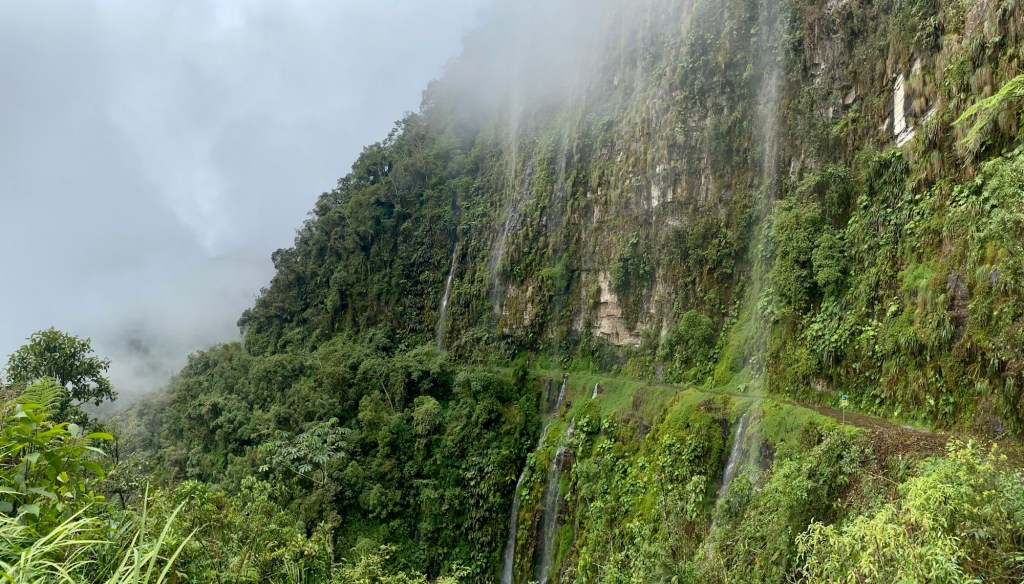
The first part was heavy on our hands but relatively uneventful. The second part was when things got really interesting. The fog was clearing a little and with the better visibility we could see how the iridescent green vegetation had claimed the dark grey mountain. The side of the mountain generally stood at a 90° angle from the road, however on some sections the mountain protruded over the road so that you cycled underneath it. Waterfalls provided another obstacle, pounding the path creating flooded sections with slippery rocks and varying the depth of the terrain. The path had also grown thinner and, with the increased visibility, we would now get flashes of just how high we really were. At some sections, the road met a sheer 600m drop.
Interestingly, some of the most beautiful parts of the road were also the most dangerous and technical. The section pictured above was my favourite, the photo unable to do the height of the crag justice. The guide informed us that this section had also claimed the most lives. On first laying eyes on the view I had missed the small wreckage of a minibus in the jungle below evidence of how the road earned its name.
Despite the roads history, being scared of heights and an inexperienced cyclist, I felt surprisingly confident riding down. I locked in on the road in front of me and whenever I did get flashes of the sudden drops or the many crosses lining the road to those who had fallen, I passed by them too quickly to properly process it.
The lower we got, the better the visibility got and the mountains gave way to valleys opposed to sheer cliffs. What was noticeable about this section was the multiple locations of recent landslides. Kenny told us that during the rainy season, landslides were common and that only a week ago they had to dump the support vehicle and carry bikes over the debris. He also said that for a month a team was working on landslide proofing a particularly prone area, putting cages over the land up top, only to find their hard work had been undone within a day and now lay at the bottom of the valley.
The road was becoming flatter with some uphill sections and many more road users. We now had chickens, dogs and children to dodge as we descended into the small village. We crossed another river and turned left into La Senda Verde, a sanctuary for wild animals who were victims of the illegal pet trade.
We dumped the bikes, grabbed our packs from the minivan and crossed a noisy muddy river via a rope bridge into the sanctuary. Once inside I instantly saw wild spider moneys swinging from branch to branch high up in the canopy. We entered a human cage, essentially a tunnel of wire protecting the animals from us. Spider and cute little squirrel moneys walked above us on the cage showing us some interest. We also saw rescued deer, capuchin monkeys, capybara, tapir, tortoises and, my favourite, a ocelote, a very handsome wild cat not much bigger than a domestic cat with amber eyes and spots like a leopard and stripes along its body.
We enjoyed a meal of pasta with a drink before all clambering back in to the minivan and took the new road back to La Paz. Once back at the hostel we enjoyed dinner in the rooftop restaurant. The bartender said he sees an injured tourist about once a week from the death road cycle. Thankful we weren’t privy to that information before we did the cycle, we fell into bed agreeing that we were both thoroughly glad we did the tour but also both pleased it was over and done, that we were safe and in one piece.

 Postcards from Mordor
Leave a reply to Kevin Chamberlain Cancel reply